
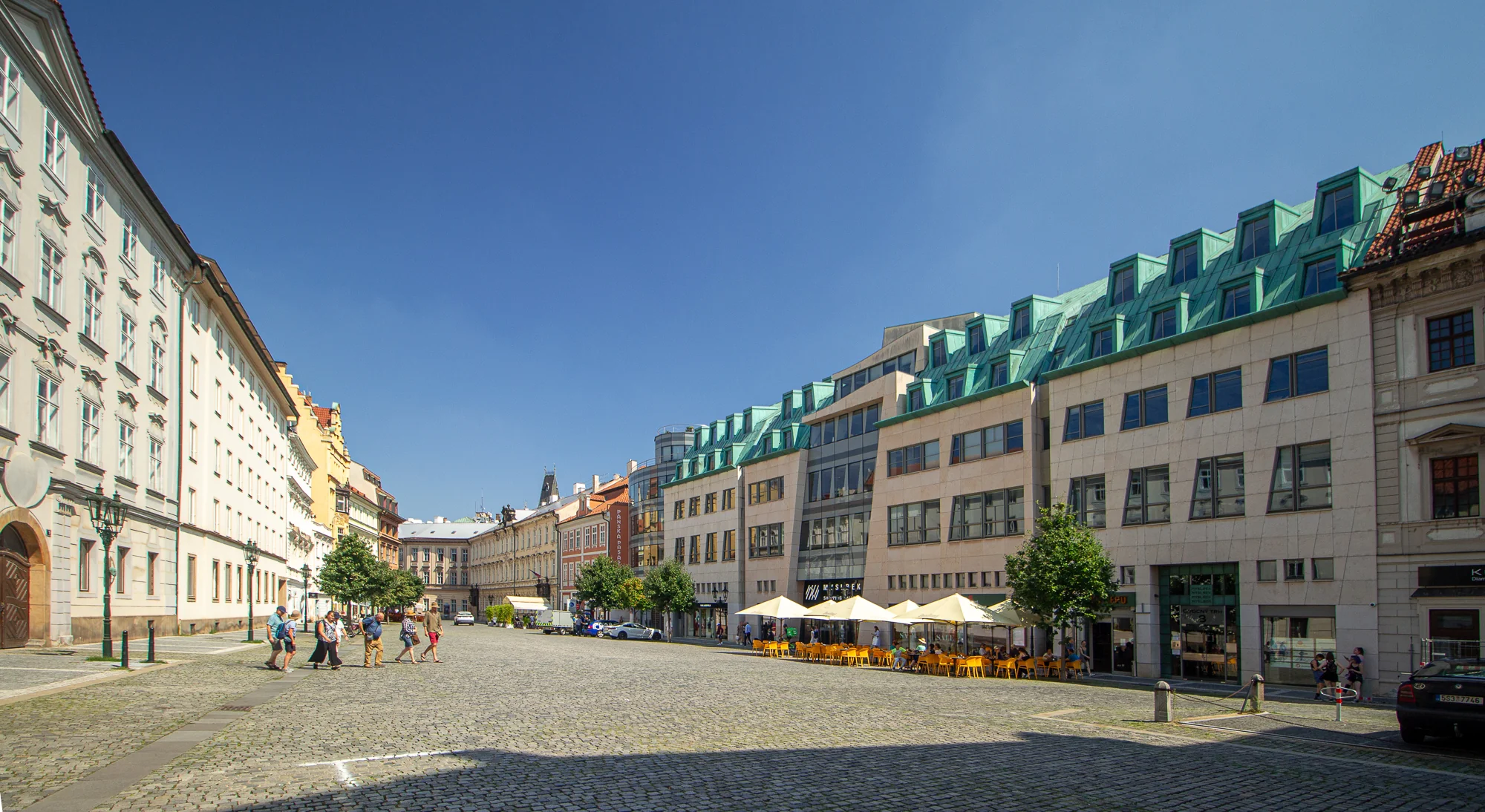
Deploying guaranteed symmetric corporate B2B internet in Prague 1 is technically and logistically significantly more demanding than implementation in a modern office park on the city's outskirts. New Telekom s.r.o. completed a FTTO 1 Gbit/s connection for a corporate client based in the historic built-up area of Prague 1 — with a 99.9% availability SLA guarantee, redundant last mile, outage response time of within 15 minutes, and 24/7 technical support — all without a single surface excavation in a heritage-protected street. The project took 9 weeks and required a combination of three different cable routes using existing historic conduits, a rooftop cable bridge, and a wireless backup link.
Why is corporate internet connectivity in Prague 1 a technically different discipline?
Prague 1 — Old Town, Josefov, Malá Strana, Hradčany, New Town — is, from a telecommunications engineer's perspective, one of the most challenging locations in the entire Czech Republic. Companies based in the center of Prague pay a price for the prestige of the address, which also manifests in the complexity of every infrastructure implementation:- Heritage protection of facades and roads: Most streets in Prague 1 are protected by the National Heritage Institute (NPÚ) and the Prague City Hall. Excavation work on historic cobblestone roads or interventions into the plaster of historic buildings require special permits with lead times of months — or are completely impossible.
- Medieval underground infrastructure: Beneath the streets of Prague 1 lies a layered palimpsest of infrastructure — from medieval cellars to Baroque water pipes, 19th-century sewers, and telecommunications ducts from the previous era. The passability of these routes for new cables is unpredictable and requires case-by-case investigation.
- Dense cable congestion: Existing telecommunications conduits in central Prague are typically fully occupied by cables from historic operators. Capacity for new pulls is very limited or non-existent.
- Built-up area without technical shafts: Historic buildings in Prague 1 were not designed with vertical cable distribution in mind. Technical shafts, which are standard in modern office buildings, are simply missing here — or are only accessible through residential spaces.
- Administration and coordination: Any intervention in public roads in Prague 1 requires coordination with the Prague Road Administration (TSK), the Prague Transport Company, the Prague Water Supply and Sewerage Company, and in some cases also with the Institute of Archaeology of the Czech Academy of Sciences — especially during any ground survey.
What was the client and what did they need?
The client — a medium-sized law firm with 40 employees based in a historic building in Prague 1 — Old Town — operates applications with high connectivity demands: a cloud DMS (Document Management System) on Microsoft Azure, VoIP telephony via SIP Trunk, a Cisco Webex videoconferencing system, and remote access for partners working across Europe through an encrypted VPN tunnel. The existing connection — an asymmetric VDSL2 circuit from a retail operator with a nominal speed of 100/20 Mbit/s — was insufficient for the growing volume of cloud traffic and provided no SLA guarantee. Outages lasting hours were not uncommon, and for a law firm, every hour without connectivity during working hours means direct financial and reputational loss. The client's requirements were clear:- Guaranteed symmetric speed of at least 1 Gbit/s — no aggregation, no capacity sharing
- 99.9% SLA availability with a defined outage response time
- Redundant last mile — no single point of failure on the access route
- Static public IPv4 addresses for operating their own VPN server and SIP registrations
- Implementation without intervention into the facade of the historic building — a condition from both the building manager and the NPÚ
How did New Telekom design the route and architecture in Prague 1?
Survey of Available Routes in the Historic Center of Prague
The first step was a detailed survey of available cable routes around the building in Prague 1. A team of New Telekom technicians examined:- Existing telecommunications ducting in adjacent streets — the survey showed minimal remaining capacity on the closest route, but a passable reserve conduit in a more distant street 340 meters away
- Existing New Telekom optical routes in the Prague 1 area — a New Telekom backbone optical fiber runs along a distant street 280 meters from the building, with available free fiber
- Rooftop routes and cable bridges — a survey of neighboring buildings revealed the possibility of running a cable across the roof of an adjacent building (with the owner's consent) into the client's technical room
- Wireless routes — a direct line of sight to the roof of a building in Prague 1 with an available connection point to the New Telekom network at a distance of 610 meters
Selected Architecture: Three Routes, One Guarantee
Primary route (fiber — via existing conduits): Utilizing a passable reserve conduit in the existing telecommunications ducting on a side street and pulling a new OS2 Single-Mode optical fiber into the building through the technical basement of a neighboring building (with the owner's consent) and a shared technical shaft. Total length of the optical route: 420 meters. Capacity: 1 Gbit/s, upgradable to 10 Gbit/s by swapping active components without cable intervention. Secondary route (fiber — via rooftop): An OS2 ADSS (All-Dielectric Self-Supporting) optical fiber routed across the roof of an adjacent building and entering the client's building through a roof penetration with IP68 sealing. This route requires no intervention in public roads. Length: 85 meters. Capacity: 1 Gbit/s. This route is physically completely separate from the primary — excavation or damage on the primary route will not affect it. Backup route (wireless — microwave link): Installation of a microwave link (Cambium PTP 550E, 5.8 GHz band, capacity 1.5 Gbit/s) on the client's roof with a direct line of sight to the roof of an opposite building in Prague 1, where a New Telekom network access point is located. The backup link activates automatically in the event of failure of both optical routes — switching within 8 seconds via SD-WAN logic on a Juniper NFX250 router. The result is three-level last mile redundancy in the historic center of Prague — exactly what the client required and what a retail operator in this location cannot provide.What was physically installed in the building in Prague 1?
Fiber Optic Distribution and Termination
- 420 m OS2 Single-Mode optical fiber on the primary route via existing telecommunications ducting and the basement of a neighboring building, terminated with LC/APC connectors in the client's data rack — route attenuation measured at 1.8 dB (class OS2 limit: 3.5 dB)
- 85 m OS2 ADSS self-supporting optical fiber on the rooftop secondary route, roof penetration with IP68 sealing, terminated in the client's data rack with LC/APC connectors — attenuation 0.4 dB
- 12-port LC/APC optical patch panel in the client's data rack for clear termination of both optical routes and connection documentation
Active Equipment
- Juniper NFX250 — SD-WAN CPE router for automatic management of the three access routes (primary fiber, secondary fiber, microwave backup link) with failover logic and BGP session to the New Telekom backbone network; support for IPv4/IPv6 dual-stack, QoS prioritization of VoIP traffic (EF DSCP), stateful firewall
- Cisco Catalyst 9200-24P — access switch with 24× GbE PoE+ ports for powering IP phones (Cisco Webex Calling system), Wi-Fi access points, and security cameras without external power; 2× 10GbE SFP+ uplink to the router
- Cambium PTP 550E — 5.8 GHz microwave backup link with 1.5 Gbit/s capacity and adaptive 4096-QAM modulation; rooftop installation oriented towards the opposite New Telekom network point in Prague 1
- APC Smart-UPS 1500VA — backup power for all active equipment for 40 minutes during a power outage
Structured Cabling Inside the Building
Horizontal distribution in the client's offices in Prague 1 was implemented using Cat 6A S/FTP cable routed in Legrand DLP cable ducts with RAL 9010 white finish — a discreet installation respecting the historic character of the interior without needing to cut into plaster:- 340 meters of Cat 6A S/FTP cable
- 2× Cat 6A patch panels 24-port
- 38 data outlets with dual RJ45 Cat 6A keystone ports
What connection parameters did the client in Prague 1 obtain?
| Parameter | After implementation | Original state (VDSL2) |
|---|---|---|
| Transmission speed | 1 Gbit/s symmetric (1:1, non-blocking) | 100/20 Mbit/s, aggregation 1:20 |
| SLA availability | 99.9% contractually guaranteed | No guarantee (best-effort) |
| Last mile redundancy | Three physically separate routes | Single route, no backup |
| Backup switchover time | < 8 seconds automatic | Manual, hours |
| Latency to NIX.CZ | < 1.4 ms | 12–40 ms (variable) |
| Latency to Azure West Europe | < 8 ms | 30–70 ms |
| Static IP addresses | 4× IPv4 static, native IPv6 /48 | Shared NAT, no static IPv4 |
| Outage response time | < 15 minutes | Undefined |
| VoIP prioritization (QoS) | Hardware, EF DSCP | None |
| Management and monitoring | New Telekom NOC 24/7 | Self-service portal |
What are the specifics of corporate B2B internet in Prague 1 compared to other locations?
Prague 1 is not just a different address — it is a different category of technical implementation. For companies considering relocating their headquarters or modernizing connectivity in central Prague, it is crucial to understand three fundamental differences: First, the survey time is longer. In a modern office park in Prague 4 or Prague 5, a site survey and route design typically take 1–2 weeks. In the historic center of Prague 1, expect 3–5 weeks — surveying cable routes in historic built-up areas, coordinating with managers of neighboring buildings, and verifying the capacity of existing telecommunications ducting simply takes longer. Second, physical implementation requires creativity. The standard solution — excavation, laying a conduit, pulling a cable — is often unavailable in Prague 1. An experienced team must combine rooftop routes, basement passages, wireless backup links, and the use of existing historic conduits in a way that requires no demolition permits and respects the conditions of both the building management and the NPÚ. Third, backup last mile is more important here than anywhere else. The dense built-up area of central Prague 1, the presence of dozens of other cables sharing limited duct space, and frequent renovations of historic roads increase the likelihood of accidental disruption of an optical route. Redundant last mile — ideally two physically separate optical routes plus a wireless backup link — is an absolute necessity for critical corporate operations in Prague 1, not a luxury.Frequently Asked Questions about Corporate B2B Internet in Prague 1
Is it even possible to get a guaranteed FTTO optical connection in a historic building in Prague 1?
Yes, but it requires an operator with experience in this location and its own optical infrastructure in central Prague. New Telekom has its own backbone optical routes in Prague 1 and experience with surveying and implementation in historic built-up areas. The key is a combination of available routes — existing telecommunications ducting, rooftop routes, passages through basements of neighboring buildings — and a backup wireless link for last mile redundancy. Every building in Prague 1 is different and requires an individual survey.How long does FTTO connection implementation take in Prague 1?
The project for the client described in this case study took 9 weeks from contract signing to handover. The survey and route design took 4 weeks (coordination with building managers, verifying cable route capacity), physical implementation 3 weeks, and testing with certification measurement 2 weeks. In Prague 4 or other modern locations, the same project would take 4–6 weeks. This time premium for a historic location is realistic and must be factored into planning.Do I need consent from the building manager or NPÚ for an FTTO connection in Prague 1?
For running a cable through common areas of the building (basement, roof, stairwell), the consent of the building manager or the Homeowners' Association is necessary — and New Telekom handles this coordination as part of the project. If the cable enters the building through a penetration in the facade or roof, an assessment by the NPÚ may be required depending on the building's protection category. In the implementation described in this case study, a roof penetration without any intervention into the facade was used, which did not require NPÚ permission — only the building manager's consent.What happens if both optical routes fail simultaneously?
In the event of failure of both optical routes, the microwave backup link (Cambium PTP 550E) with 1.5 Gbit/s capacity automatically activates within 8 seconds — the client will experience a brief connectivity interruption, but traffic will resume without manual intervention. The microwave link uses a physically completely different transmission path (radio waves in the 5.8 GHz frequency band) and is not affected by excavation work or optical cable damage. A simultaneous failure of all three routes is an extremely unlikely scenario.Does New Telekom offer corporate internet in other parts of Prague 1 — Malá Strana, Josefov, Hradčany?
Yes. New Telekom provides corporate B2B internet throughout Prague 1 — Old Town, Josefov, New Town, Malá Strana, and Hradčany. The availability of a specific route and technology depends on the building's location and the result of a site survey. Contact us for a free site survey — our team in Prague has experience with implementations in the historic center and will design the optimal solution for your specific address in Prague 1.Conclusion
The corporate B2B internet project in the historic center of Prague 1 demonstrates that guaranteed symmetric connectivity with redundant last mile and 99.9% SLA is available even in locations where standard approaches fail. The key is a combination of experience with local infrastructure, creative cable routing without surface excavations, and three-level access route redundancy — primary fiber via historic conduits, secondary fiber via rooftop, and a microwave backup link. For a law firm in Prague 1, this means in practice the end of best-effort connectivity with unpredictable outages and a transition to enterprise connectivity with guaranteed parameters, latency to NIX.CZ below 1.4 ms, and New Telekom technical support available 24/7. Do you have an office in Prague 1 or the historic center of Prague and are looking for guaranteed corporate internet with real last mile redundancy? Contact us via the contact page — we will conduct a free site survey and design a solution that works even where other operators say it is impossible.This case study was prepared by the expert team of New Telekom s.r.o. Technical parameters correspond to the state on the project handover date. The client's industry and number of employees are disclosed with the client's consent; the exact address of the building is not disclosed for commercial reasons. Information corresponds to the technological state as of February 2026.
Technologies and Standards Used
- Juniper NFX250 — SD-WAN CPE router with BGP, IPv6, QoS DiffServ
- Cisco Catalyst 9200-24P — access switch with PoE+
- Cambium PTP 550E — 5.8 GHz microwave backup link, 4096-QAM
- OS2 Single-Mode optical fiber — primary route via existing telecommunications ducting
- OS2 ADSS self-supporting optical fiber — secondary rooftop route
- Cat 6A S/FTP — structured cabling according to ČSN EN 50173-1, class EA
- Fluke Networks DSX2-8000 — structured cabling certification
- EXFO FTB-720 — OTDR attenuation measurement of optical routes
- LC/APC connectors — optical terminations with attenuation below 0.2 dB
- NIX.CZ — Neutral Internet eXchange Prague, New Telekom direct peering
- RIPE NCC — IP address space and BGP AS management
- NPÚ — National Heritage Institute, Prague
- TSK Prague — Prague Road Administration
- ČSN EN 50173-1 — structured cabling for commercial spaces
- 3GPP LTE-A Pro — backup mobile connectivity (New Telekom eSIM)