
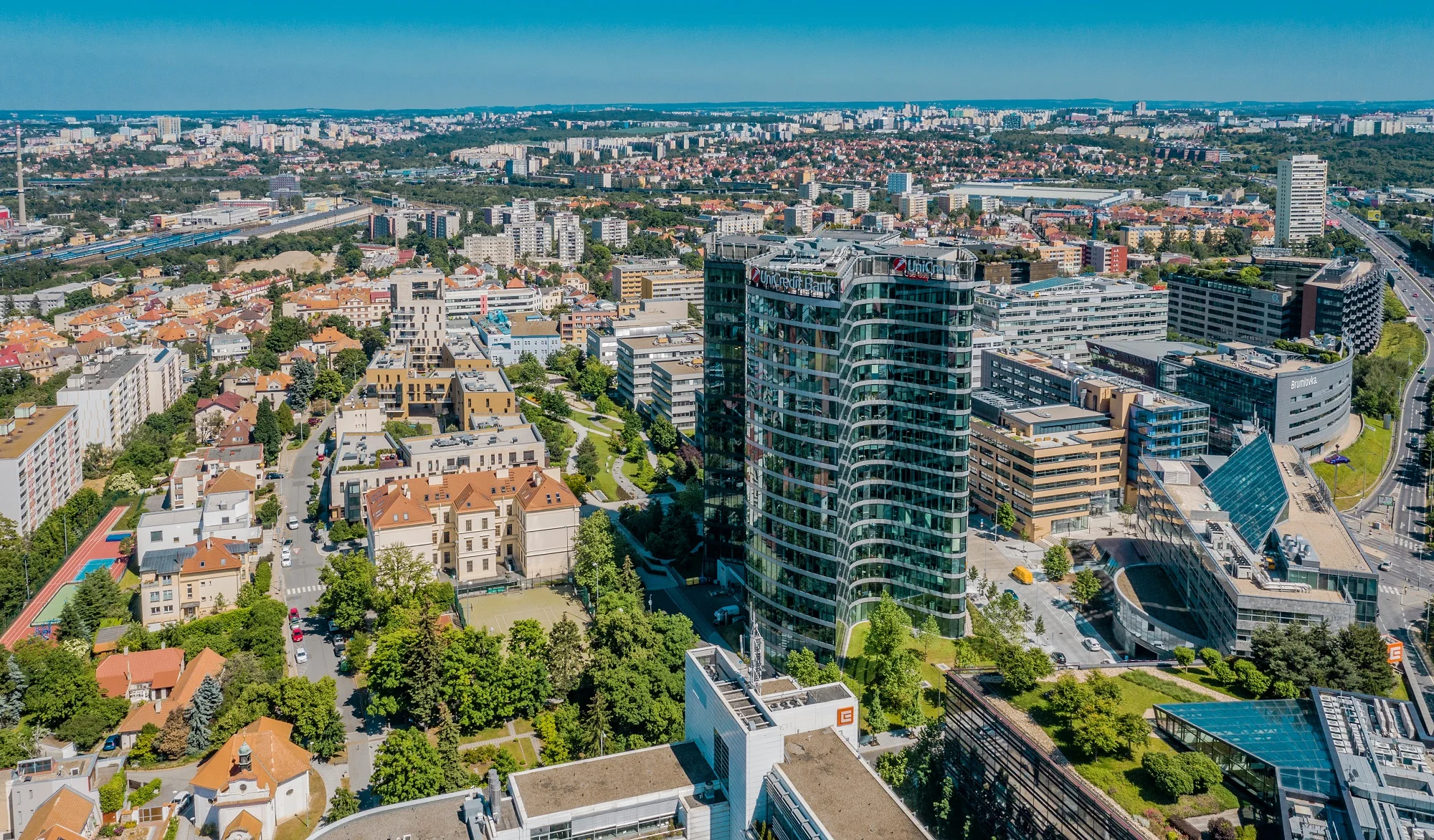
What was the initial situation and why did the complex in Prague 4 need new B2B connectivity?
This was a large multi-tenant administrative and commercial complex in the Prague 4 — Michle area — a location with a high concentration of corporate tenants — which at the time of implementation housed dozens of corporate tenants, from medium-sized enterprises to branches of multinational corporations. The existing network infrastructure on the premises had been built gradually by various contractors and suffered from critical shortcomings:- Inadequate physical infrastructure: Backbone cabling was based on Cat 5e copper cable, with maximum transmission capacity insufficient for modern corporate applications — Microsoft 365, Google Workspace, SAP, videoconferencing systems Cisco Webex and Microsoft Teams.
- Lack of SLA: The existing connection operated on a best-effort basis with no contractual guarantee of availability or response time to outages. Outages lasting hours were not uncommon.
- Shared capacity: Bandwidth was aggregated at a ratio of up to 1:30 — during peak afternoon traffic, there was a significant drop in transmission speeds.
- No redundancy: A single access route (last mile) meant that physical cable damage or active equipment failure caused a complete loss of connectivity for the entire complex. In the densely built-up Prague 4 — Michle area, excavation work by third parties represents a real risk of disrupting the single last mile segment.
- Incompatibility with cloud requirements: Tenants operating on AWS, Microsoft Azure, or Google Cloud Platform faced insufficient symmetric upload — critical for database backups, replication, and VoIP calls.
How did New Telekom design and justify the chosen architecture?
Site Survey and RF/Optical Analysis in the Prague 4 Premises
The first step was a site survey — a team of New Telekom technicians physically inspected all buildings in the complex, mapped existing cable routes, technical shafts, telecommunications closets (TCs), and entry points for connection to the public optical infrastructure in Prague 4. Simultaneously, an optical measurement of existing routes was carried out using the OTDR (Optical Time Domain Reflectometer) method to determine attenuation characteristics. The survey results confirmed that the copper infrastructure was unsuitable for projects above 1 Gbit/s and that the physical routes within the complex allowed for the laying of new optical fiber without the need for extensive construction interventions — using existing cable ducts and technical shafts.Selected Architecture: Star Optical Topology with a Central Node
New Telekom proposed a star optical topology with a single central distribution frame (MDF) located in the technical basement of the complex's main building. From the central node, dedicated FTTO optical routes lead to each floor distributor (IDF) and from there to individual tenants. Key architectural decision: no shared segment on the route from the tenant to the central node. Each tenant has their own optical pair — physically separated from other tenants. This architecture eliminates risks of interference, cross-talk, and security issues associated with a shared medium.What was physically laid and installed in the complex in Prague 4?
Optical Backbone — 3.2 km of new cable in Prague 4
The physical implementation included laying a total of 3,200 meters of new optical fiber within the Prague 4 — Michle premises:- Backbone optical fiber of type OS2 Single-Mode 24-fiber on the route from the entry point (connection to the New Telekom public optical route in Prague 4 — Michle) to the central MDF node — a total of 420 meters with through attenuation below 0.35 dB/km
- Backbone inter-building routes within the complex — OS2 Single-Mode 12-fiber cable with a total length of 680 meters, laid in HDPE 40/33 conduits in the ground and on existing cable bridges between buildings
- Vertical riser cables in building technical shafts — OS2 Single-Mode 8-fiber cable, totaling 1,100 meters throughout the buildings
- FTTO horizontal distribution to individual tenants from floor distributors IDF — OS2 Single-Mode 2-fiber cable, totaling 1,000 meters
Active Equipment — Juniper Networks and Cisco
The central MDF node was equipped with the following active technology:- Juniper Networks MX204 — backbone router for connection to the New Telekom network with 400 Gbit/s capacity, hardware support for BGP, MPLS, IPv6, and QoS (DiffServ)
- Juniper Networks EX4650 — core switch with 48× 25GbE SFP28 ports and 8× 100GbE QSFP28 uplinks for capacity distribution within the complex
- Cisco Catalyst 9300-48P — access switches in floor distributors IDF with PoE+ (30 W/port) support for powering IP phones, Wi-Fi access points, and IP cameras without the need for separate power supply
- Fortinet FortiGate 601F — next-generation firewall (NGFW) for separating the premises network from the internet, with hardware SSL/TLS inspection, IPS (Intrusion Prevention System), and application control — throughput 80 Gbit/s
- Juniper Networks NFX250 — SD-WAN CPE device for managing primary and backup connections with automatic failover switching
Backup Connectivity — SD-WAN with LTE Backup
The primary connection of the Prague 4 premises to the New Telekom backbone network is realized by two physically separate optical routes — primary and backup — running along different streets in Prague 4 so that excavation work or damage on one route does not compromise the other. Redundant last mile is crucial in the densely built-up environment of Prague 4: historically, the last mile segment is the most frequent location of physical optical route disruption. Both routes have 10 Gbit/s capacity. As a third level of redundancy, an LTE/5G backup connection is installed on the Juniper NFX250 router with a New Telekom eSIM card — in the event of failure of both optical routes, traffic automatically switches to mobile data connection with 1 Gbit/s capacity (aggregated LTE-A Pro in B1/B3/B7 bands within Prague coverage). The switchover occurs within 8 seconds without manual intervention.Structured Cabling and Patch Panels
In addition to the optical route, New Telekom provided complete Cat 6A structured cabling (category 6A, 10GBase-T, shielded S/FTP) in tenant spaces for data outlets and local distributions:- 1,840 meters of Cat 6A S/FTP cable in tenant spaces
- 24× Cat 6A patch panels, 24-port with keystone connectors and color-coded path management
- Cable trays and cable ducts in office spaces with capacity for future expansion
How was the connection of individual tenants implemented?
Individual FTTO Connections for Each Tenant in Prague 4
Each tenant in the Prague 4 complex received their own FTTO connection — a physically dedicated optical pair from the floor distributor IDF to the tenant space. On the tenant side, the optical fiber is terminated on an optical patch panel in the tenant's data distribution rack and connected to a media converter or directly to the SFP+ port of the tenant's active device. Transmission speeds are configured individually according to each tenant's contract — ranging from 100 Mbit/s symmetric (for smaller offices with 5–15 users) to 1 Gbit/s symmetric (for tenants operating cloud applications, VoIP systems, or video walls). The capacity is non-blocking — the tenant has their guaranteed speed available in full at any time.Management and Monitoring via New Telekom NOC
All active infrastructure in the complex is continuously monitored by the New Telekom NOC (Network Operations Center) in Prague using SNMP v3, NetFlow, and syslog protocols. The monitoring system tracks in real-time:- Utilization of each optical link and active port
- BGP session state on the Juniper MX204 backbone router
- Availability of each FTTO connection using ICMP ping with 30-second intervals
- Temperature and power supply of active devices
- Status of UPS and backup LTE/5G connection
What connection parameters did the tenants achieve after implementation?
After commissioning the entire infrastructure, the corporate B2B internet connection in the Prague 4 — Michle complex achieved the following measured parameters:| Parameter | Value after implementation | Original state |
|---|---|---|
| Maximum backbone capacity | 10 Gbit/s (upgradable to 100 Gbit/s) | 1 Gbit/s shared |
| Capacity aggregation | 1:1 (non-blocking) | 1:30 |
| Latency to NIX.CZ | < 1.2 ms | 8–25 ms (variable) |
| Latency to AWS eu-central-1 (Frankfurt) | < 9 ms | 25–60 ms |
| Latency to Azure West Europe | < 8 ms | 22–55 ms |
| Availability SLA | 99.9% contractually guaranteed | No guarantee (best-effort) |
| Response time to outage | < 15 minutes | Undefined |
| Access route redundancy | Dual fiber + LTE/5G backup | None |
| Backup switchover time | < 8 seconds automatic | Manual, hours |
| IPv6 support | Native dual-stack IPv4/IPv6 | IPv4 only |
| Static IP addresses | Assigned per tenant request | Shared NAT |
| BGP support | Available for tenants with AS number | Not supported |
How does the project meet NIS2 requirements and security standards for companies in Prague?
A portion of tenants in the Prague 4 complex are entities from sectors subject to NIS2 (EU Directive 2022/2555, transposed by Act No. 181/2014 Coll.) — financial services, IT, and digital infrastructure. The implemented architecture meets security requirements at the network layer:- Physical isolation of transmission routes — each tenant has a dedicated optical pair, with no physically shared medium with other tenants
- Fortinet FortiGate 601F NGFW firewall with IPS, SSL/TLS inspection, and application control separates the premises network from the public internet
- Logical segmentation of each tenant into its own VRF (Virtual Routing and Forwarding) on the Juniper MX204 backbone router — one tenant's traffic is not visible or accessible to other tenants in the same complex
- Encrypted management of all active devices exclusively via SSHv2 and SNMPv3 — no plaintext protocol
- Audit logs from all network devices are exported to the central syslog server at New Telekom NOC in Prague with 90-day retention
What do the numbers say — implementation summary in Prague 4 — Michle
The corporate B2B internet project for this Prague 4 complex in numbers:- 3,200 m of new OS2 Single-Mode optical fiber laid within the premises
- 1,840 m of Cat 6A S/FTP structured cabling in tenant spaces
- 1× Juniper MX204 backbone router, 1× Juniper EX4650 core switch
- 12× Cisco Catalyst 9300-48P access switches in IDF distributors
- 1× Fortinet FortiGate 601F NGFW firewall
- 1× Juniper NFX250 SD-WAN CPE with LTE/5G backup
- 24× Cat 6A patch panels 24-port
- 2× physically separate backbone optical routes 10 Gbit/s to/from Prague 4
- SLA 99.9% for each tenant, response time < 15 minutes
- Latency to NIX.CZ < 1.2 ms, to Frankfurt < 9 ms
- Total project duration from contract signing to handover: 11 weeks
Frequently Asked Questions about Corporate B2B Internet in Prague
Can New Telekom provide a similar solution for other administrative buildings or complexes in Prague?
Yes. New Telekom implements corporate B2B internet projects for administrative buildings, business parks, industrial areas, and logistics centers throughout Prague — including Prague 1 (city center), Prague 4 (Michle, Pankrác, Chodov), Prague 5 (Stodůlky, Zličín), Prague 8 (Karlín, Kobylisy), and industrial zones near the D1, D5, and D8 highways. New Telekom's own optical backbone network in Prague enables connection without reliance on third parties.How long does it take to implement an FTTO optical connection for an office complex in Prague?
The standard project duration from contract signing to handover depends on the scope — for a medium-sized complex (5–20 tenants), expect 8–14 weeks. The project for the Prague 4 complex was completed in 11 weeks, including laying 3.2 km of fiber, installing active equipment, and certification measurement. For simpler projects (one building, one tenant), we can commission the connection within 2–4 weeks.Is it possible to guarantee different speeds to different tenants in one complex in Prague?
Yes, and it is a standard part of our solution for multi-tenant complexes in Prague. Each tenant has their own FTTO connection with individually set guaranteed speed — from 100 Mbit/s to 10 Gbit/s symmetric. The speed can be changed at any time without physical intervention in the infrastructure, only by reconfiguration at the network layer. The tenant pays only for the capacity they actually need.Does New Telekom also offer management of the entire network infrastructure of a complex in Prague as a managed service?
Yes. In addition to providing connectivity, New Telekom offers for Prague complexes a managed service including management of active devices, their firmware updates, proactive monitoring, security policy management on Fortinet FortiGate, and regular network performance reports. The property management thus does not need its own network engineer — everything is handled by the New Telekom NOC in Prague continuously 24/7.Conclusion
The corporate B2B internet project for the multi-tenant complex in Prague 4 — Michle demonstrates that even in an existing multi-tenant administrative building, a full-fledged enterprise network infrastructure can be built to meet modern companies' requirements for guaranteed speed, low latency, redundancy, and security — within a reasonable timeframe and without disrupting tenant operations. Guaranteed latency below 1.2 ms to NIX.CZ, dual redundant optical backbone with automatic failover, individual FTTO connections for each tenant, and 99.9% SLA with a 15-minute response time — these are parameters that shared commercial connections or a retail ISP in Prague cannot provide. If you manage an administrative complex, industrial area, or business park in Prague or anywhere in the Czech Republic and are looking for a provider of guaranteed corporate B2B internet with their own optical infrastructure and direct peering at NIX.CZ, contact the expert team at New Telekom via the contact page or take a look at the overview of internet services for businesses. We will design a solution tailored precisely to your premises' needs.This case study was prepared by the expert team of New Telekom s.r.o. Technical parameters correspond to the state on the project handover date. The exact name and address of the building are not disclosed for commercial reasons. Information corresponds to the technological state as of March 2026.
Technologies and Standards Used
- Juniper Networks MX204, EX4650, NFX250 — backbone and access network equipment
- Cisco Catalyst 9300-48P — access switches with PoE+
- Fortinet FortiGate 601F — NGFW firewall with IPS and SSL inspection
- OS2 Single-Mode optical fiber — backbone and horizontal optical distribution
- Cat 6A S/FTP — structured cabling according to ČSN EN 50173-2
- ČSN EN 50346 — measurement of optical routes using EXFO FTB-720 certification reflectometer
- Fluke Networks DSX2-8000 — Cat 6A structured cabling certification
- 3GPP LTE-A Pro — backup mobile connectivity via New Telekom eSIM
- BGP, MPLS, IPv6, QoS DiffServ — backbone network protocols
- SNMPv3, NetFlow, SSHv2, syslog — infrastructure management and monitoring
- NIX.CZ — Neutral Internet eXchange, Prague — New Telekom direct peering
- RIPE NCC — regional internet registry, IP address space management
- EU Directive 2022/2555 (NIS2) — security requirements for operators of essential services
- ISO/IEC 27001 — standard for information security management